
How to Invest in Real Estate Without Buying Property
Published on
December 9, 2025
Interested in growing wealth through investing in rental homes? Join the Priority Access List today.
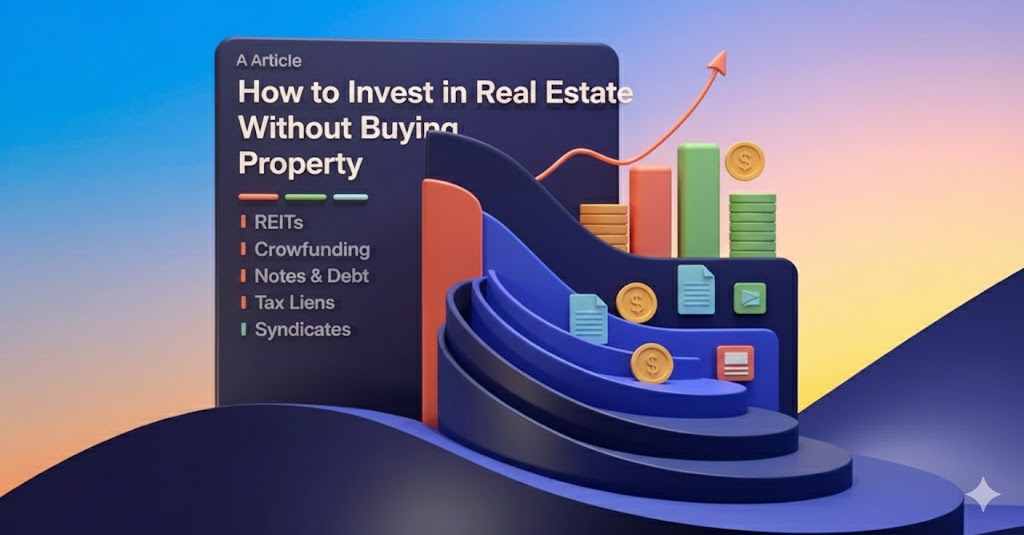
How to invest in real estate without buying property has become one of the most common questions among new and seasoned investors alike. This is more pertinent for individuals who would like to reap the benefits of real estate investments without going through the hassles associated with property acquisition. Today’s market offers more ways than ever to tap into property-driven income streams using tools that are flexible, beginner-friendly, and available even if you’re working with modest capital.
Key Takeaways:
- You can invest in real estate without directly buying property through options like REITs, ETFs, crowdfunding platforms, real estate notes, and tokenized assets.
- Strategies involving non-ownership real estate allow for starting small, diversification, and the generation of passive real estate income without having to concern with property upkeep.
- What works well for you will depend on your objectives, so often the best results come from a combination of several different approaches.
This guide breaks down the smart ways you can get into real estate investing and how to get started with confidence.
What It Means to Invest Without Buying Property
When you choose to invest in real estate without buying property, you virtually get exposure to the real estate market with no direct investment. It means you do not own, operate, or maintain any real estate property. You will not be purchasing a house, a unit, or a commercial property, but you will be purchasing investment tools that own or provide finance for those properties, such as shares in a real estate investment fund.
Such investments allow you to participate in rental income, property value appreciation, or mortgage interest in a more indirect, passive manner. Based on the investment option that you choose, you may hold an interest in multiple properties situated in different cities or different countries, as opposed to being geographically tied.

Advantages of Non-Ownership Real Estate Investing
If you want to invest in real estate without taking on the full burden of property ownership, non-ownership strategies can offer several compelling benefits:
- Lower capital requirement: When one purchases a property, there may be a huge down payment required, as well as closing costs.
- Diversification across properties and sectors: Such diversification may reduce risks while benefiting from the subsequent growth.
- Liquidity and easier entry or exit: Unlike selling real property (which takes weeks or months), in some real estate securities such as stocks, you can easily sell or buy.
- Hands-off or passive investing: You don't have to be a landlord, so you don't deal with rent, repairs, or property management issues.
- Access to professional real estate expertise: Many investments in this category would be managed with expertise in real estate.
Risks and Limitations to Consider
That said, non-ownership real estate investing isn’t free of drawbacks. Here are key risks and limitations you should weigh carefully:
- Liquidity constraints (for some vehicles): Especially with crowdfunding or private deals, your funds may be locked for a fixed term.
- Less control over property management or decisions: Because you don’t own the property directly, you typically have no say in management aspects.
- Returns not guaranteed or subject to market and economic conditions: Indirect real estate investments still react to broader economic and market factors.
- Potential for lower growth compared to direct ownership (in some cases): Because some non-ownership vehicles distribute a large portion of their income, they may reinvest less into new properties, which could limit long-term value growth.
- Fees and underlying costs may reduce net returns: Some funds or online real estate platforms charge management or performance fees.
- Dependence on the performance and integrity of third-party property managers or platforms.
How to Invest in Real Estate Without Buying Property
If you’re wondering how do you invest in real estate without buying a physical building or land, you’re tapping into a growing set of strategies that let you gain exposure to real-estate markets without becoming a landlord.
1. Real Estate Investment Trusts (REITs): The Easiest Entry Point

One of the most popular ways to understand how to invest in real estate without buying a property is through Real Estate Investment Trusts (REIT). A REIT is essentially a company that owns or finances income-producing real estate like apartments, offices, warehouses, retail centers, and divides the income (from rents or financing) among its shareholders. According to data by NAREIT, REITs have delivered an average annual return of around 12.3% over 25 years, and many continue to offer attractive dividend yields while being easily tradable on stock exchanges.
Pros:
- Low barrier to entry or you can start with relatively small amounts
- Liquidity - You can buy or sell easily
- Diversification across different property types (residential, industrial, commercial real estate), which helps spread risk.
Cons:
- Market volatility risk because their share prices can fluctuate like any other stock
- You don’t get to choose the individual rental properties, tenants, or management decisions
- The dividend reliability depends on performance
2. Real Estate Crowdfunding Platforms
For those asking how to invest in online real estate without buying property, real estate crowdfunding offers another path. Crowdfunding platforms pool money from many investors to fund property developments or income-producing real estate, then share profits (rent, interest, or sale proceeds) among investors. Globally, the real estate crowdfunding market is projected to grow significantly. Some reports cite median annual returns in the 8%–12% range for many platforms.
Pros:
- Low minimum investment requirements
- Potential for high returns over the medium term compared with traditional savings or bonds
- Diversification across properties and geographies
Cons:
- Liquidity constraints and lock-in periods
- Dependence on platform and project management
- Higher risk compared to publicly traded REITs
3. Real Estate Mutual Funds and ETFs

Another way on how to invest in property without being a landlord is via real estate mutual funds and ETFs. These funds pool money from many investors and invest in a mix of real-estate related assets, often shares in Real Estate Investment Trusts (REITs) or real-estate companies. For example, a top-performing real-estate ETF such as Vanguard Real Estate ETF (VNQ) has delivered multiyear average returns in the ballpark of what many investors expect from balanced investment portfolios.
Pros:
- Diversification across many properties and sectors
- Lower barrier to entry or low minimum investment
- Liquidity and flexibility especially ETFs trade on exchanges, meaning you can buy or sell your shares during market hours
Cons:
- Less direct control over properties
- Returns can fluctuate with market sentiment and interest rates
- Less opportunity for property-level tax advantages
4. Real Estate Notes and Debt Investing
Another method to invest is by purchasing real estate notes (also called mortgage or promissory notes) or investing via real estate debt funds. In this setup, you essentially become the lender. You put up capital, the note is secured by a property, and in return you receive regular interest payments from the borrower. The investor doesn’t deal with tenants, maintenance, or property management; they simply earn fixed or variable income from debt repayment.
Pros:
- Predictable passive income stream since payouts are interest payments from the loan borrower
- Capital preservation (in many cases)
- You don’t have to deal with landlords’ headaches; your exposure is purely financial
Cons:
- Illiquidity because notes and debt-fund investments are often harder to sell than public-market securities
- If the borrower fails to repay, there’s a risk you lose income and may need to foreclose
- Changes in interest rates, property values, or housing market cycles can affect returns
5. Real Estate Syndications (Passive Partnerships)

A third approach is investing through real estate syndications. This is a method whereby a pool of individuals may invest together as a group to purchase one or more properties. In this method, the investor becomes the limited partner, whereas the person with expertise in purchasing and subsequently selling the property is known as the sponsor or syndicator. This method is ideal for many individuals who would like to invest but do not want to be landlords.
Pros:
- Potential for high returns (equity upside + income)
- Ownership of real assets, with possible tax advantages
- As a limited partner, you don’t need to worry about day-to-day operations, etc.
Cons:
- Once you invest, your money is typically locked in for a multi-year holding period
- Dependence on sponsor’s skill and transparency
- Less diversification compared to funds
6. Real Estate Development Funds
Investing via a real-estate development fund means you (along with other investors) pool capital to fund development projects rather than buying a ready property. This kind of fund finances land acquisition, construction, and development with the goal of selling or leasing the finished properties for profit. According to industry sources, development-oriented real estate funds can target internal rates of return (IRR) of 15–25%+ when projects succeed (versus lower yields on stabilized properties).
Pros:
- Because you’re backing development, there’s often an opportunity for significant gains if the project sells
- Asset-backed; good as inflation hedge
- Access to larger or institutional-grade projects
Cons:
- Capital is often tied up for years until the development completes and properties are sold or leased
- Development risk — delays, cost overruns, market risk
- As an investor you rely heavily on the fund’s property manager
7. Tokenized Real Estate and Blockchain-Based Property Assets
With the rise of blockchain and digital finance, a newer option emerges: real estate tokenization. This involves converting property (or shares in property) into digital tokens on a blockchain. Each token represents a fractional stake in a building or a pool of properties. For many investors asking how you can invest with little money, tokenization can lower the barrier, allowing you to own a small fraction of property rather than needing a full down payment.
Pros:
- Low minimum investment — fractional real estate investing possible
- Potential for greater accessibility and global diversification
- Efficiency, transparency, and flexibility (on paper)
Cons:
- Regulatory and legal uncertainty
- Liquidity and market-depth issues
- Technology and security risks
Concreit: A Simple, Automated Way to Dip Into Real Estate
Concreit has emerged as one of the more accessible platforms for investors who want exposure to real-estate-backed yields without committing large sums or dealing with long holding periods. The app pools investor capital into short-term, income-producing real estate loans and pays out dividends, making it particularly attractive for people who want a steady income stream but don’t have thousands to tie up. Its low minimum investment, automated approach, and liquidity-friendly structure place it in a unique category between traditional REITs and crowdfunded real estate debt.
Choosing the Best Investing Strategy for You
Selecting the right way to invest in real estate without owning property depends on your investment goals, risk tolerance, and available capital. You may use REITs, ETFS, and mutual funds if your preferences lean towards passively managed, liquid investments. You may use syndications, real estate development, or real estate debt as your investment alternatives if your aim is higher returns with higher risk. What seems most important is that every investment solution fits your objective, investment term, as well as your risk tolerance.
It’s also a good idea to diversify your real estate investments. A combination of different real estate investments, such as REITs, crowdfunding real estate, or even real estate tokens, may provide a more well-rounded experience.

How to Build a Diversified Real Estate Portfolio Without Buying Property
Even if you’re not buying physical assets, investing in properties through financial instruments still allows you to build a diversified real estate portfolio.
1. Mix Investment Vehicles
Diversify your investments with REITs, ETFs, mutual funds, or real estate crowdfunding platforms.
2. Spread Across Sectors
Add rental properties such as single family residential, commercial, industrial, and mixed-used properties.
3. Use Both Equity and Debt Exposure
Set aside a portion for real estate debt or notes with a focus on rental income, as well as equity investments.
4. Geographic Diversification
Invest in properties or platforms across multiple regions or countries to reduce reliance on a single market.
5. Consider Short-Term and Liquid Options
Include platforms like Concreit, T-Bill + REIT combos, or tokenized real estate to maintain flexibility and access to cash.
Explore our related article on how to invest in real estate with little money.
The Bottom Line
Learning how to invest in real estate without buying property opens the door to opportunities that are flexible, affordable, and surprisingly powerful for long-term wealth building. Using the right tools, found in today’s financial landscape, you will be able to leverage the same rewards that property owners enjoy.
The key is finding the right investments based on your goals, risk tolerance, and time frames. When done right, non-ownership real estate investing can be every bit as lucrative as buying real estate , but without the hassles associated with mortgages, renting, and property upkeep.
Frequently Asked Questions (FAQs)
How much money do I need to invest to make $3,000 a month?
The amount depends on the investment type, average yield, and factors like taxes and fees. As a simple example, generating $36,000 per year would require roughly $900,000 at a 4% yield, $720,000 at 5%, or $600,000 at 6%. Higher-yield options (e.g., 8–10% in private credit or real estate debt) could lower the required capital to about $360,000–$450,000, but they also involve higher risk, greater variability, and often less liquidity. Actual outcomes vary based on market performance, distribution changes, expenses, and tax treatment, so this should be viewed strictly as a rough illustration—not a promised result.
What is the lower-risk way to invest in real estate without owning a property?
REITs, publicly traded real estate ETFs, and high-rated real estate notes are generally considered lower risk than private real estate deals because they offer liquidity, regulatory oversight, and diversification. However, they are not risk-free. They can still be affected by market volatility, dividend cuts, and interest-rate fluctuations. Evaluating these options should depend on your risk tolerance, time horizon, and income goals.
How much money do I need to start investing in real estate indirectly?
Many platforms let you start with $10 to $500, depending on the method. REITs and ETFs can be purchased for the price of one share, crowdfunding platforms sometimes require $10–$1,000 minimums, and micro-investing apps often have no minimum at all.
Are non-ownership real estate investments suitable for beginners?
Absolutely. They are often ideal for beginners because they require low capital, no property management, and offer built-in diversification. They also allow new investors to learn the housing market without taking on the risks of physical ownership.
Disclaimer
This information is educational, and is not an offer to sell or a solicitation of an offer to buy any security which can only be made through official documents such as a private placement memorandum or a prospectus. This information is not a recommendation to buy, hold, or sell an investment or financial product, or take any action. This information is neither individualized nor a research report, and must not serve as the basis for any investment decision. All investments involve risk, including the possible loss of capital. Past performance does not guarantee future results or returns. Neither Concreit nor any of its affiliates provides tax advice or investment recommendations and do not represent in any manner that the outcomes described herein or on the Site will result in any particular investment or tax consequence.Before making decisions with legal, tax, or accounting effects, you should consult appropriate professionals. Information is from sources deemed reliable on the date of publication, but Concreit does not guarantee its accuracy.


