
What a Different Housing Market Cycle Means for Real Estate Investors
Published on
March 7, 2026

Interested in growing wealth through investing in rental homes? Join the Priority Access List today.
The housing market cycle is not a theoretical concept. It’s a living entity that impacts investment performance, real estate value, and strategic planning. Knowing how the housing market moves through a boom-bust cycle, and then repeats, is a key strategic advantage for real estate investors. And today, the housing market cycle is different. It’s slower, uneven, and influenced by unique post-pandemic and macroeconomic forces. So what does that mean for you as an investor?
Key Takeaways
- A different housing market cycle means slower, uneven growth that demands flexible, data-driven strategies.
- Local insights matter most, as regional trends now drive investment performance more than national averages.
- Long-term value-based investing is key, and renovations are the way to win.
In this article, we’re going to walk through the phases of the housing cycle, how to navigate them, and where the market is now (as of 2026).
What Is the Housing Market Cycle?
The housing market cycle is a repeating pattern of expansion, peak, contraction, and recovery that occurs in real estate markets. This is a natural occurrence that is influenced by a variety of economic factors, such as interest rates, employment trends, and shifts in housing supply and demand. Economists generally agree that there are four phases of the real estate cycle, which are recovery, expansion, hypersupply, and recession. This is a natural occurrence that has been observed throughout the years, and many researchers have identified a repeating cycle of about 18 years. Though timing varies by region and economic changes or market conditions.

Why the Housing Market Follows an Up and Down Cycle
Unlike stocks, real estate is a physical asset shaped by broader economic forces that drive the house market cycle. Key factors include:
- Interest rate movements: When the interest rates change, the borrowing capacity also changes.
- Housing supply constraints: New construction volumes can lag demand by years.
- Demographic shifts: Migration patterns and population growth impact housing demand.
- Investor psychology: Optimism and pessimism also contribute to the real estate market cycles.
What Are the 4 Phases of the Real Estate Cycle?
To understand how the housing market cycle works, it’s essential to explore the four key phases that define its rhythm. Each stage carries distinct signals for investors, influencing when to buy, hold, or sell. Let’s break down these phases in detail, because where you are in the real estate cycle will ultimately shape your investment strategy.
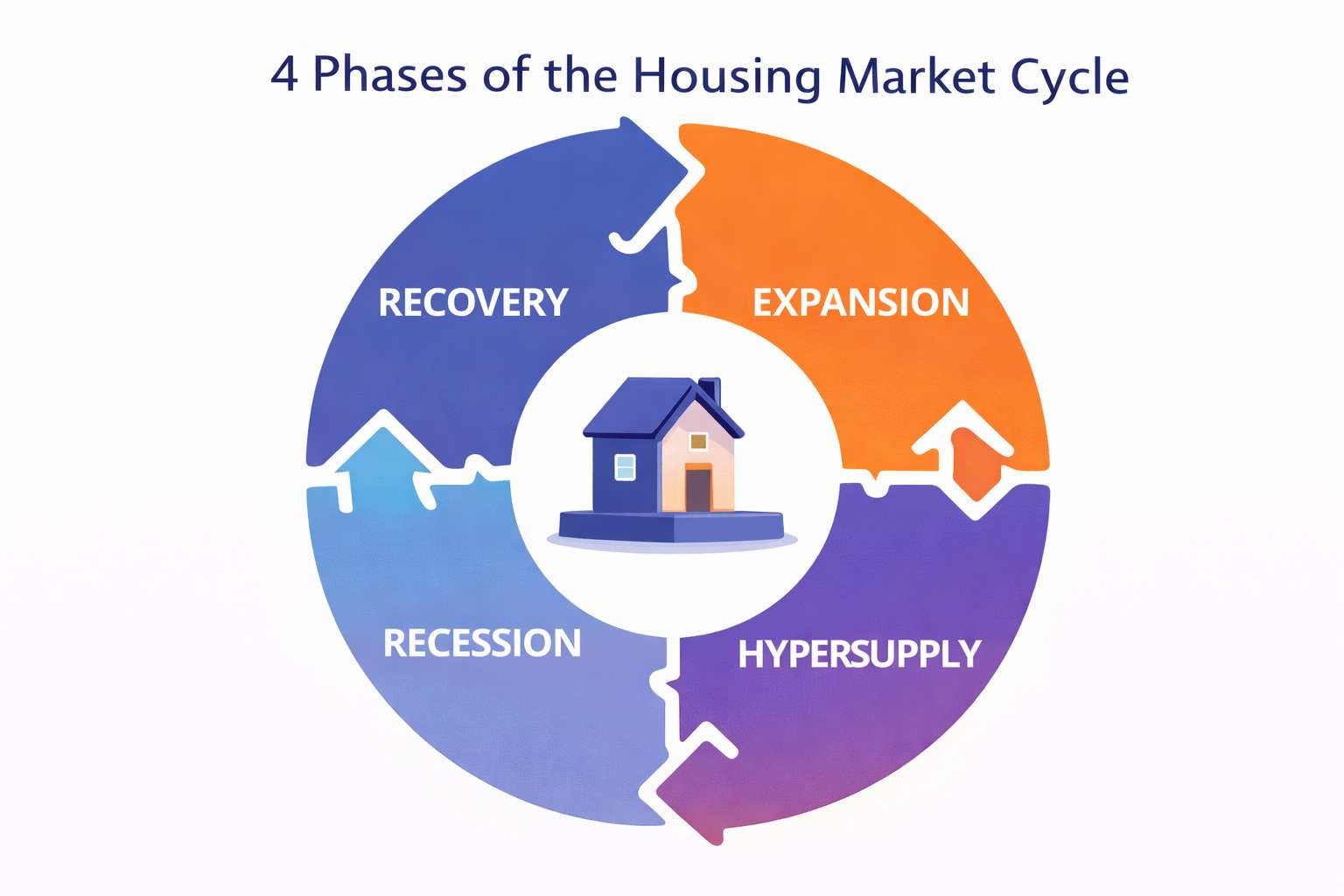
1. Recovery: Early Stage Rebound
During the recovery phase, house prices have typically bottomed out, creating a foundation for gradual improvement. Inventory levels often remain elevated because sellers are still cautious and housing demand hasn’t fully returned. However, home sales activity begins to pick up as confidence slowly rebuilds in the market. Interest rates during this time are usually low or supportive. For property investors, this phase presents a prime opportunity to buy early. Properties are generally undervalued and rental yields tend to look attractive.
2. Expansion: Growth and Strength
In the expansion phase, the rates of growth for both house price and home sales accelerate as the level of confidence among buyers increases and the overall economic conditions improve. However, the rate at which construction activity occurs to meet the increased housing demand starts to cause inventory to become less available, thereby creating a competitive situation with rising house prices. This phase is referred to as the classical “bull housing market,’ with steady growth in property values and strong opportunities for rental income. From the point of view of the investor, owning properties at this time can create strong opportunities for growth, although the cost of acquiring new properties continues to increase.
3. Hypersupply: Growth Slowing, Inventory Rising
In the hypersupply phase, the rate of growth for the overall market starts to slow as the rate of construction either exceeds or falls short of the overall housing demand. In this phase, the level of inventory starts to rise, thereby signaling that the housing supply might not meet the demand for them. In this phase, the rate of growth for property values starts to slow, and the growth rate for rents starts to level off. This phase can be regarded as the transition phase. The overall success of the market at this time can be affected by some cooling. The focus at this time should be on the overall efficiency of the properties.
4. Recession: Contraction and Cooling
In the recession phase, house prices usually go down or remain stagnant due to the slowing down of buyer activity and the accumulation of inventory in comparison to housing demand. Home sales slow down and market sentiment becomes cautious. Investors and homeowners become wary of making major moves. Sellers become reluctant to sell their properties and transactions slow down. Despite these difficulties, this phase also brings forth some of the best opportunities for long-term investors to gain from the properties that are on sale at lower house prices. Learn more about how to prepare for a recession here.
How the Housing Market Cycle Affects Investment Decisions
Understanding where you are in the cycle helps you make informed decisions rather than emotional ones.

Here’s how housing cycle dynamics influence investment and financial decisions:
Capital Allocation
When we are in the expansion phase in the real estate cycle, investors may prefer to invest in growth assets such as investing in multifamily apartments or investing in a property in a high-growth area. During recession phases, the preference often shifts to defensive assets, like affordable rentals with stable cash flow.
Timing of Purchases
Market timing matters. Purchasing in recovery or early expansion can significantly improve long-term returns because you benefit from both income and early price appreciation.
Exit Strategy Planning
During hypersupply or recession, exit strategies become even more critical. Having provisions for refinancing, selling at peak demand in certain submarkets, or repositioning the asset can protect returns when the broader market cools.
Risk Management
Understanding the phase of the cycle helps with managing risk. For example, in slower property markets, due diligence should emphasize local employment trends, vacancy rates, and rent growth, not just headline price data.
Where Are We in the Housing Market Cycle?
So where are we right now? As of early 2026, the U.S. housing market shows traits of a slow expansion or early transition. Not a classic housing market boom, but not outright recession either. To understand this phase, it helps to look at housing market cycles history, which reveals that after every major run-up in house prices and tightening of inventory, markets typically move into a gradual cooling period before stabilizing. Here are the market dynamics in early 2026:
- Mortgage rates have dipped below 6% for the first time since 2022 — a positive development for buyer affordability. (AP News)
- Existing home sales were down in January but house prices remained high, suggesting persistent demand amid tight inventory. (KW Agent Sites)
- Experts note that the “lock-in effect” (where low-rate holders delay selling) is fading, potentially increasing inventory. (Fortune)
- Some analysts forecast price increases in certain regions and modest softness in others as balance returns. (JPMorgan Chase)
The market is in a transitioning phase; more balanced than the post COVID-19 pandemic boom but not yet in decline. Investors face a slow-growth environment where opportunities remain, especially in undervalued or secondary markets with strong rental demand. In this stage, understanding the real estate market is key. Success depends on targeting resilient areas and prioritizing value-add or renovation strategies over a simple buy-and-hold strategy.

Key Implications of a Shifting Cycle for Real Estate Investors
As the property market cycle shifts, its implications change too. Here’s how that plays out for investors:
1. Capitalizing on Lower Rates and Affordability Bumps
Falling rates, even modest ones, can expand buyer pools and improve refinancing opportunities. Investors should monitor mortgage rates and yield curve data closely as part of deal timing.
2. Greater Importance of Rent-Driven Cash Flow
With home sales slowed, rental demand remains a cornerstone of investor returns. Markets with diverse job opportunities tend to have stronger rental fundamentals.
3. Local Market Divergence Gets Real
National market trends can mask big regional differences. Some metros may lead with robust growth, while others lag or soften. This makes local due diligence essential.
4. Shift Toward Value-Add and Renovation Plays
In a market where the overall growth is slowing, value-added strategies, such as renovating older properties to a higher level of quality to gain rent premiums, can be more profitable.
How Investors Can Profit from the Property Cycle
Knowing how to profit from each of the different phases of the property cycle allows an investor to work with the market, rather than against it. This means that an investor can capitalize on the different opportunities that each phase of the cycle brings. The key to profiting from the property cycle is to understand what phase of the cycle the market is in.
Here are some strategies that an investor can use to profit from each of the different phases of the property cycle:
Understanding the 18-Year Real Estate Cycle
The 18-year real estate cycle is a long-term cycle that helps to understand the expansion, peak, contraction, and recovery of real estate. This cycle occurs over a long period of time, usually between 15 and 20 years. Unlike the stock exchange, which fluctuates constantly, the real estate life cycle is slow-moving. This is supported by historical evidence of cycles that peak at regular intervals of 18 years, such as in 1974, 1990, 2008, and 2024. This is followed by a recovery phase, after which a new real estate cycle begins due to overbuilding and leverage.
However, not every cycle follows the same economic patterns. In some real estate markets, the cycles are shorter, while in others are longer. For example, real estate cycles are shorter in regions with high growth rates. In contrast, property cycles are longer in regions that are mature and have a housing shortage. While the exact duration varies, the 18 year housing cycle remains one of the most reliable lenses for understanding real estate’s recurring nature.
Conclusion: A Different Kind of Cycle, a Strategic Advantage
The housing market cycle today is vastly different from what we saw in the past. Today’s real estate cycles are slow-moving and are affected by a variety of factors, such as increasing construction costs and housing shortages. As a result, real estate cycles are becoming more localized and regional variations are playing a larger role.
For investors, this environment demands strategic flexibility and patience rather than speculative fervor. While opportunities exist, particularly in undervalued and/or high-growth secondary markets, success in this environment requires disciplined analysis and creative value-add strategies.
Frequently Asked Questions
1. What are the different types of market cycles?
Market cycles represent the recurring phases of growth and contraction in various industries. In the case of real estate, the major types of market cycles include recovery, expansion, hypersupply, and recession.
2. What life cycle stages are part of a real estate asset?
In the case of real estate, an asset normally passes through the stages of acquisition or real estate development, maturity, stabilization, and disposition or renewal.
3. What are the stages of real estate investment?
The stages of real estate investment include stages of research and market analysis, stages of acquisition, stages of management and value creation, and stages of exit and reinvestment.
4. How do U.S. housing experts analyze market cycles?
When explaining how U.S. housing experts analyze market cycles, analysts study key indicators like mortgage rates, housing starts, inventory levels, employment data, monetary policy, and Federal Reserve policies. They combine national and local data to determine whether the market is expanding, contracting, or stabilizing.
Disclaimer
This information is educational, and is not an offer to sell or a solicitation of an offer to buy any security which can only be made through official documents such as a private placement memorandum or a prospectus. This information is not a recommendation to buy, hold, or sell an investment or financial product, or take any action. This information is neither individualized nor a research report, and must not serve as the basis for any investment decision. All investments involve risk, including the possible loss of capital. Past performance does not guarantee future results or returns. Neither Concreit nor any of its affiliates provides tax advice or investment recommendations and do not represent in any manner that the outcomes described herein or on the Site will result in any particular investment or tax consequence.Before making decisions with legal, tax, or accounting effects, you should consult appropriate professionals. Information is from sources deemed reliable on the date of publication, but Concreit does not guarantee its accuracy.


