
9 Reasons Why Real Estate Can Be A Good Investment
Published on
August 21, 2026

Interested in growing wealth through investing in rental homes? Join the Priority Access List today.
Real estate can be a good investment for investors who seek an asset that can generate income and build value over time. However, it does not mean that the purchase of real estate automatically leads to profits. There are multiple factors such as location, financing, expenses, property type, and the manner how the investment is managed. Being aware of both advantages and risks can help investors decide where real estate fits within a broader investment strategy.
Key Takeaways:
- Real estate can provide multiple types of returns, namely rental income, appreciation, equity growth, and tax benefits.
- Risks of real estate investing include vacancies, property depreciation, repairs, increasing expenses, and low liquidity.
- The best way to invest depends on your financial goals and resources, with options ranging from rental properties and house flipping to REITs and crowdfunding.
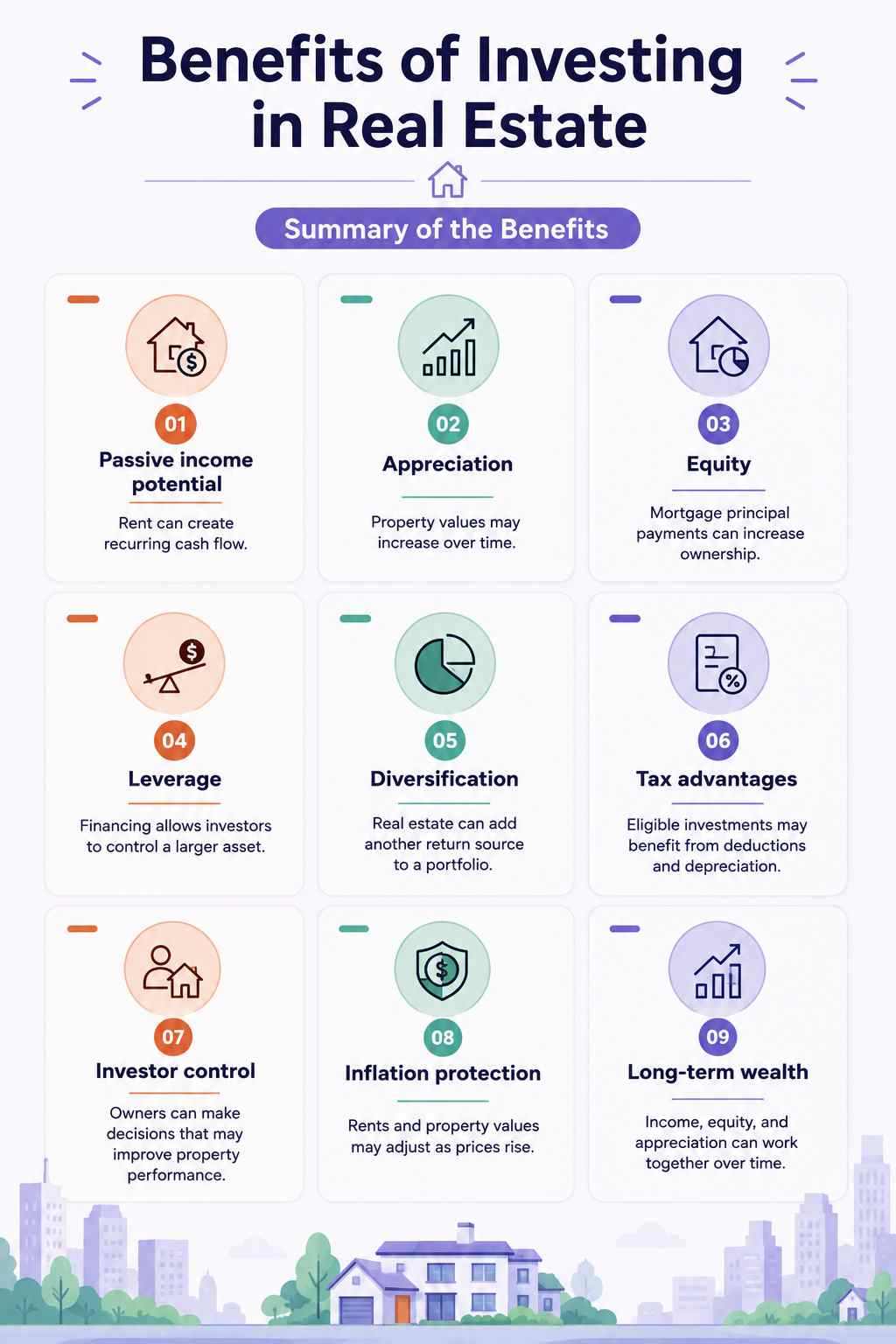
9 Reasons Real Estate Can Be a Good Investment
The benefits of investing in real estate go beyond the possibility of a property becoming more valuable. Here are nine reasons why investors consider investing in real estate despite the risks.
1. Real Estate Can Create Potential Passive Income
With rental real estate, there is an opportunity to generate income through rent payments. Once expenses such as mortgage payments, taxes, insurance, repairs, management, and vacancies are deducted from the total, investors can receive additional sources of income.
The degree of passive income is determined by the way the property is managed. Management can be carried out by an investor himself (which can be quite intensive), or with the help of a property manager. Passive income is one of the essential components of returns in publicly traded real estate. According to Nareit, more than half of the total returns of equity REITs are formed by dividends.

2. Property Values Can Appreciate Over Time
Real estate can potentially appreciate over time. However, this is not guaranteed. Changes in housing supply, population, employment, development of the neighborhood, construction costs, and demand can affect housing prices.
The Federal Housing Finance Agency House Price Index tracks U.S. single-family home values using data that reaches back to the mid-1970s. Its extensive historical data illustrates how residential property values have changed across different economic and housing cycles. The important distinction is between long-term appreciation and assuming prices will rise every year. Individual investment properties and local markets can decline, sometimes for extended periods.
3. Real Estate Can Help Build Equity
A financed property gives an investor another potential wealth-building mechanism: equity.
Each mortgage payment consists of both principal and interest payments. Each time the principal portion is paid, the loan balance decreases. If the property retains its value, the equity of an owner increases. Rental properties are funded partly by tenants' rent payments, which help to cover the expenses and mortgage debt. That can allow an investor to build equity without funding every mortgage payment entirely from other income.

4. Investors Can Use Leverage
Real estate is one of the few major asset classes where individual investors commonly use borrowed money to acquire a much larger asset.
Leverage cuts both ways, though. A decline in property value can magnify losses relative to the investor's original equity, while mortgage payments continue regardless of whether a property is occupied or producing enough income. That makes the cost and structure of financing just as important as the purchase price.
5. Real Estate Can Provide Portfolio Diversification
Usually, investors use real estate in addition to stocks, bonds, and cash, and not as an alternative to them. Market performance is determined by a number of factors: rental demand, supply of properties, financing conditions, and economic activity in the particular area. Those drivers are not always identical to the forces moving stock market or bonds.
Research compiled by Nareit on real estate diversification notes that listed REITs have historically shown low-to-moderate correlations with broader stocks, bonds, and other assets. Diversification cannot eliminate losses. It can, however, reduce the extent to which an investment portfolio depends on a single asset class or source of return.
6. Real Estate May Offer Tax Advantages
Investment real estate can come with tax benefits that differ from those of many traditional investments. There are deductible expenses for operating a rental property and depreciation of qualifying property. According to IRS Publication 527, residential rental buildings are generally depreciated over 27.5 years using the General Depreciation System.
Depreciation can reduce taxable rental income even though it is a non-cash expense. At the same time, depreciation can affect the property's adjusted tax basis and may have consequences when the property is eventually sold. The tax rules can become complicated quickly and depend on the circumstances of each particular case. Prior to investment, a qualified tax specialist should be consulted by an investor.

7. Investors Have More Control Over the Asset
The control over the real estate allows the investor to determine many aspects of the property: renovations, rent setting, tenant selection, financing, property management, and selling the property. That ability to influence an asset's performance is one reason active investors are drawn to real estate.
More control also means more responsibility. Poor renovations, excessive financing, deferred maintenance, or ineffective management can decrease the value of the property.
8. Real Estate Can Serve as an Inflation Hedge
Due to inflation, many goods and services become more expensive over time. Real estate has characteristics that may provide some protection in inflationary environments. Property owners may be able to increase rents as leases renew, while rising construction and replacement costs can support the value of existing investment properties in some markets.
That relationship is not perfect, however. The increasing inflation can also increase mortgage interest rates, resulting in expensive mortgages and declining property prices.
9. Real Estate Can Create Long-Term Wealth
Real estate's long-term appeal comes from the possibility of combining several return drivers within one investment. An investor may collect rental income while tenants help pay down a mortgage. At the same time, the underlying property may appreciate, creating additional equity.
That combination can become meaningful when repeated over many years. Investors may also reinvest cash flow or equity into additional properties, creating another potential source of compounding.
However, there are no guarantees that all the mentioned benefits will be provided by a particular property. Nevertheless, if the property was acquired at a reasonable price and is financed correctly, and owned for a long period of time, it can be a good way to build wealth.
Risks of Real Estate Investing to Consider
Is investing in real estate a good idea for everyone? Not necessarily. The same properties of real estate, which attract investors can also become a serious risk. Prior to the investment, one needs to take into account the less pleasant side of property ownership.
- Property value declines: The value of real estate can fall due to interest rate changes, oversupply of properties, population changes, economic recession, or problems specific to this property.
- Vacancies and tenant problems: Vacant rental property generates no income, while late payments, property damage, disputes, and evictions can be a problem for the landlord.
- Unexpected repairs: Roofs leak. Water heaters fail. Plumbing breaks. All of these can happen suddenly and can require considerable cash expenses.
- Rising insurance and property taxes: Expenses can grow even if the income stays the same. Insurance costs can be significant in hazardous areas.
- Interest-rate risk: Investors using variable-rate debt can face higher payments when interest rates rise. Higher market rates can also make refinancing more difficult or expensive.
- Local economic downturns: Real estate is highly local, and the exit of major employers or population decline can negatively impact rents, occupancy, and property values.
- Liquidity risk: Selling a property usually takes considerably longer than selling a publicly traded stock.
What Are the Different Ways to Invest in Real Estate?
Another factor when asking is real estate a good investment right now is how you plan to invest. Here are five common ways to get real estate exposure.
1. Buy and Hold Rental Properties
An investor purchases either residential real estate or commercial property, which is rented to tenants. The goal is generation of rental income combined with appreciation and mortgage pay-down, if the property is owned long enough. The drawback of this method is active management which includes search for tenants, property management, expenses, and financing.

2. Flipping Houses
Flipping houses means that an investor purchases the property, renovates it, and sells for a higher price. Success of the strategy depends on the ability to purchase the property at the right price and correctly estimate the expenses of renovation, financing, and the sale price.
3. Real Estate Investment Trusts (REITs)
Instead of direct acquisition of real estate, REITs allow investors to get exposure to the asset in a more accessible way. Publicly traded REITs own or finance portfolios of properties of different types, including apartment buildings, warehouses, offices, retail buildings, hotels, health care facilities, and data centers. That provides liquidity and makes diversification across multiple properties easier. However, investors give up most of the control over the property.
4. Real Estate Crowdfunding
Real estate crowdfunding platforms allow many investors to pool their funds into investments in individual properties, loans, or portfolios of properties. Depending on the online platform, the minimal investment can be much smaller than down payment needed for purchase of the whole property. In addition, investors may get access to the properties which would be inaccessible without real estate crowdfunding.
5. Real Estate Partnerships
Investors can also pool capital through partnerships, syndications, or other private real estate structures. One party, often a sponsor or general partner, typically identifies and manages the investment. Other investors provide capital and participate economically according to the partnership agreement. This structure can provide exposure to larger properties and professional management without requiring every investor to become a landlord.
The Bottom Line
So, is real estate a good investment? It can definitely be for the right investor and the right property. Real estate provides several ways of generating income such as rental income, appreciation, equity growth, and tax advantages, while giving investors tangible assets. However, the property is not the only factor determining the results of the investment. Purchase price, mortgage financing, location, expenses, management, leverage, and investment horizon can determine whether the investment is going to be profitable or not.
For those investors who want to get another opportunity to invest in real estate, Concreit offers professionally managed real estate investment solutions, designed to make the asset class more accessible. As with any investment, review the strategy, risks, fees, liquidity terms, and your own financial goals before investing.
Frequently Asked Questions
Is commercial real estate a good investment?
It depends on the property, housing market, tenants, financing, and purchase price. Commercial properties provide rental income and may have longer leases than residential ones. However, they require larger capital investments and are sensitive to business conditions.
Is it better to invest in real estate or stocks?
Neither is universally better. Stocks are more liquid, and provide an opportunity to get diversified by making smaller investments. Direct real estate investment allows generating rental income, leveraging, tax deductions, and more control over the asset.
Is it still good to invest in real estate?
Real estate can be a good investment if the numbers work. Instead of trying to figure out whether the entire housing market is good or bad, investors should analyze individual opportunities by the criteria of price, income, expenses, financing, location, and potential return.
Which real estate investment is best?
There is no one investment suitable for everyone. Direct rental property can be attractive for those who want to control the asset, while REITs can suit better for those who prefer accessibility and convenience. The choice is dictated by the capital, risk tolerance, desired liquidity, and investment horizon.
Is real estate a good investment for beginners?
Real estate can be a good investment for beginners, but the way of investing makes a difference. Buying and managing a rental property requires much larger financial resources and knowledge than investment in REITs. Before making an investment, a beginner should understand how returns are being generated, what fees and expenses apply, and when the money can be withdrawn.
How much money do you need to start investing in real estate?
This varies widely, depending on the way of investing. Down payment may be necessary to purchase a physical property. Other investment methods such as REITs have much lower requirements.
Disclaimer
This information is educational, and is not an offer to sell or a solicitation of an offer to buy any security which can only be made through official documents such as a private placement memorandum or a prospectus. This information is not a recommendation to buy, hold, or sell an investment or financial product, or take any action. This information is neither individualized nor a research report, and must not serve as the basis for any investment decision. All investments involve risk, including the possible loss of capital. Past performance does not guarantee future results or returns. Neither Concreit nor any of its affiliates provides tax advice or investment recommendations and do not represent in any manner that the outcomes described herein or on the Site will result in any particular investment or tax consequence.Before making decisions with legal, tax, or accounting effects, you should consult appropriate professionals. Information is from sources deemed reliable on the date of publication, but Concreit does not guarantee its accuracy.


